This article was created with AI writing assistance (ChatGPT, Claude, etc.). Product selection, specifications, and reviews are verified by the Japan Life Lab editorial team.
This article contains promotional / affiliate links.
⏱ The short answer (30 seconds)
In a hurry? The full reasons and prices are right below.
- King KW65 1000/6000 Combination StoneBest for Beginners
- Shapton Kuromaku (Pro) #1000Best Splash-and-Go Ceramic
- Naniwa Chosera/Professional #1000Best Premium Stone
- Suehiro Cerax 1000/3000Best Value Combination
- MinoSharp Plus 3 (by Global)Best Easy Pull-Through Sharpener
※ If in doubt, go with #1. Budget picks are further down the page.
Why You Need a Japanese Whetstone in 2026
A great Japanese knife is only as good as its edge — and nothing restores a razor-sharp edge like a Japanese whetstone. While pull-through sharpeners grind away metal and damage thin Japanese blades, a water whetstone polishes a precise, long-lasting edge that protects your investment for decades.
Whetstones can look intimidating, but the basics are simple, and Japan makes the best stones in the world. This guide explains how to choose and use a whetstone, then recommends 5 outstanding Japanese sharpening stones and tools for 2026 — from a beginner-friendly combination stone to a pro-grade ceramic — all available worldwide via Amazon and Buyee. (Pairs perfectly with our guide to the best Japanese kitchen knives.)
How to Choose a Japanese Whetstone
Understanding grit numbers
Grit measures how coarse or fine a stone is. A coarse stone (#220–#400) repairs chips and very dull edges; a medium stone (#800–#1000) is the everyday workhorse for sharpening; a fine stone (#3000–#8000) polishes and refines for a mirror, razor edge. For most home cooks, a #1000/#6000 combination stone covers everything you need.
Combination vs. single-grit stones
A double-sided combination stone (e.g. #1000/#6000) is the best value and ideal for beginners — one stone does both sharpening and polishing. Serious sharpeners prefer separate single-grit stones for better size and control, building a progression of coarse, medium, and fine.
Soaking vs. splash-and-go
Traditional water stones must soak in water for 5–10 minutes before use. ‘Splash-and-go’ ceramic stones (like Shapton and Naniwa) need only a splash of water, making them faster and more convenient — great if you sharpen often or dislike the mess.
Angle and technique
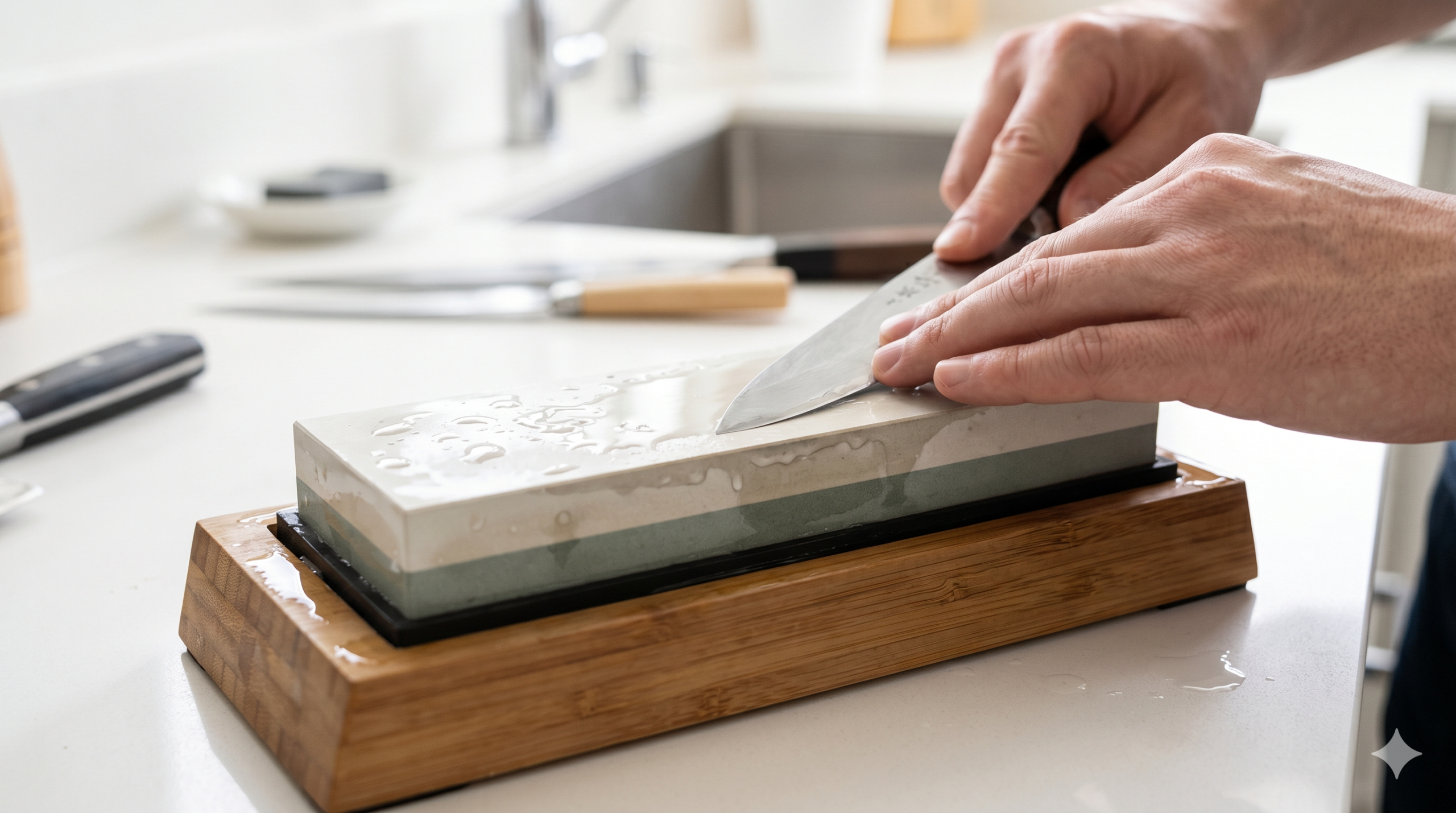
Hold the blade at a consistent 15–20° angle (about the width of two coins under the spine) and push across the stone with light pressure. Many beginner kits include an angle guide. Keep the stone wet, raise a slight burr on each side, then finish on the fine grit.
Maintenance: keep your stone flat
Stones wear hollow over time, which ruins your edge. Use a flattening (nagura) stone or sandpaper to keep the surface flat. Dry stones fully before storing to prevent cracking, and never use cooking oil — water only.
The 5 Best Japanese Whetstones & Sharpeners in 2026
1. King KW65 1000/6000 Combination Stone — Best for Beginners
The King KW65 is the whetstone almost every beginner starts with, and for good reason. This dual-sided water stone pairs a #1000 grit for everyday sharpening with a #6000 grit for polishing to a keen, refined edge — everything a home cook needs in one affordable stone.
Made by Matsunaga (King), Japan’s most trusted whetstone maker, it’s forgiving, effective, and inexpensive. Soak it for a few minutes and you’re ready to bring any kitchen knife back to razor sharpness. The perfect first stone.
| Type | Combination water stone |
|---|---|
| Grit | #1000 / #6000 |
| Use | Soak before use |
| Maker | King (Matsunaga) |
| Price range | approx. $35–50 |
✅ Pros
- Unbeatable value for beginners
- Both sharpening and polishing in one stone
- Made by Japan’s most trusted brand
- Forgiving and easy to learn on
⚠️ Cons
- Requires soaking before use
- Wears faster than premium ceramics
👍 Who it’s for
- First-time whetstone users
- Home cooks wanting one do-it-all stone
- Anyone on a budget
2. Shapton Kuromaku (Pro) #1000 — Best Splash-and-Go Ceramic
A favorite of professional chefs and sharpening enthusiasts, the Shapton Kuromaku (‘Pro’) ceramic stone cuts fast and needs only a splash of water — no soaking. The hard ceramic removes metal quickly and stays flat longer than traditional stones.
Each grit comes in a handy storage case that doubles as a base. The #1000 is the ideal everyday sharpening grit; pair it with a #5000 for polishing. If you sharpen often and want speed and convenience, the Kuromaku is hard to beat.
| Type | Ceramic, splash-and-go |
|---|---|
| Grit | #1000 (range available) |
| Use | No soaking needed |
| Maker | Shapton |
| Price range | approx. $40–60 |
✅ Pros
- Fast cutting hard ceramic
- Splash-and-go, no soaking
- Stays flat longer
- Pro-favorite, durable
- Handy storage/base case
⚠️ Cons
- Single grit (build a progression)
- Pricier than basic combo stones
👍 Who it’s for
- Cooks who sharpen frequently
- Those who want speed and convenience
- Users building a multi-stone set
3. Naniwa Chosera/Professional #1000 — Best Premium Stone
The Naniwa Chosera (also sold as ‘Professional’) is widely regarded as one of the finest sharpening stones made. This premium splash-and-go stone offers superb feedback, fast cutting, and an exceptionally smooth, consistent finish prized by knife enthusiasts.
Magnesia-bonded for a pleasant, muddy feel that gives great control, it raises a fine slurry that polishes beautifully. If you’ve caught the sharpening bug and want a stone that performs at the highest level, the Chosera is a benchmark.
| Type | Premium splash-and-go |
|---|---|
| Grit | #1000 (range available) |
| Use | Light splash |
| Maker | Naniwa |
| Price range | approx. $70–95 |
✅ Pros
- Superb feedback and control
- Fast cutting, smooth finish
- Top-tier quality
- Minimal soaking needed
⚠️ Cons
- Premium price
- Single grit
👍 Who it’s for
- Enthusiasts who love sharpening
- Those wanting the best finish
- Owners of premium knives
4. Suehiro Cerax 1000/3000 — Best Value Combination
The Suehiro Cerax 1000/3000 is a fantastic mid-range combination stone that punches well above its price. The #1000 side handles everyday sharpening while the #3000 refines the edge to a clean, sharp finish — a great step up from basic beginner stones.
Suehiro is a respected Japanese maker, and the Cerax cuts quickly with a pleasant feel and minimal soaking. It’s an excellent choice for anyone who wants better performance than an entry stone without paying premium prices.
| Type | Combination stone |
|---|---|
| Grit | #1000 / #3000 |
| Use | Brief soak |
| Maker | Suehiro |
| Price range | approx. $45–65 |
✅ Pros
- Great value combination stone
- Fast cutting, pleasant feel
- Step up from beginner stones
- Respected Japanese maker
⚠️ Cons
- #3000 finish less mirror-like than #6000+
- Combination size smaller than singles
👍 Who it’s for
- Cooks ready to upgrade from a basic stone
- Value seekers wanting quality
- Those wanting one versatile stone
5. MinoSharp Plus 3 (by Global) — Best Easy Pull-Through Sharpener
Not everyone wants to learn freehand stones — and the MinoSharp Plus 3 is the best easy option for Japanese knives. Designed by Global, this ceramic water sharpener uses spinning ceramic wheels and a water reservoir to gently sharpen thin Japanese blades without the aggressive grinding of cheap pull-throughs.
Three stages (coarse, medium, fine) let you maintain and refine an edge in seconds, no skill required. It’s the perfect choice for keeping Japanese knives sharp at home with zero fuss — especially for Global and other double-bevel knives.
| Type | Ceramic water sharpener |
|---|---|
| Stages | 3 (coarse/medium/fine) |
| Use | Add water, pull through |
| Maker | MinoSharp (Global) |
| Price range | approx. $50–70 |
✅ Pros
- No skill required
- Gentle ceramic wheels (knife-safe)
- Fast everyday maintenance
- Great for Global/double-bevel knives
⚠️ Cons
- Less precise than freehand stones
- Not for single-bevel knives
👍 Who it’s for
- Those who don’t want to learn stones
- Busy cooks wanting quick touch-ups
- Owners of Global and Western-style knives
Quick Comparison Table
| Stone / Tool | Best for | Grit | Type | Price |
|---|---|---|---|---|
| King KW65 | Beginners | #1000/#6000 | Combination | $35–50 |
| Shapton Kuromaku | Frequent sharpening | #1000 | Ceramic splash-go | $40–60 |
| Naniwa Chosera | Premium finish | #1000 | Premium splash-go | $70–95 |
| Suehiro Cerax | Best value combo | #1000/#3000 | Combination | $45–65 |
| MinoSharp Plus 3 | Easy / no skill | 3 stages | Pull-through | $50–70 |
Final Verdict
If you’re new to sharpening, start with the King KW65 — it does everything for very little money. Sharpen often? The Shapton Kuromaku is fast and convenient. Want the very best finish, go Naniwa Chosera; want great value, the Suehiro Cerax; and if you’d rather not learn stones at all, the MinoSharp Plus 3 keeps your knives sharp in seconds.
A whetstone is the single best companion to a quality Japanese knife — and with worldwide shipping via Amazon and Buyee, keeping your blades razor-sharp has never been easier.
Frequently Asked Questions
What grit whetstone should a beginner buy?
A #1000/#6000 combination stone like the King KW65 is ideal. The #1000 side sharpens dull edges and the #6000 side polishes them keen — covering everything most home cooks need in one affordable stone.
Can I use a pull-through sharpener on Japanese knives?
Avoid cheap carbide pull-throughs — they grind away metal and can chip thin, hard Japanese blades. If you want a pull-through, use a gentle ceramic water sharpener like the MinoSharp Plus 3, designed for Japanese double-bevel knives.
How often should I sharpen my knife?
With regular home use, sharpen on a whetstone every few weeks to couple of months, depending on use. Hone or strop more often to maintain the edge between full sharpenings.
Do I need to soak my whetstone?
Traditional water stones (like the King KW65) need 5–10 minutes of soaking. ‘Splash-and-go’ ceramic stones (Shapton, Naniwa) only need a splash of water and are ready immediately.
🗾 More Japan Buying Guides
🔥 Editor’s Picks for Life & Travel in Japan
📘 The Japan Expat Starter Kit 2026
Banking, housing, My Number, taxes, 100 phrases and a 40-kanji cheat sheet — everything from this site in one 17-chapter PDF field manual. Free lifetime 2026 updates.
Reader price: $9.99 $6.99 with code JLL30 at checkout
30-day money-back guarantee · Instant download · PR
🛒 Ready to Buy? Shop These in Japan!
Get fast delivery across Japan — including same-day in major cities
Practical guides for life and travel in Japan — free, about once a week. No spam, unsubscribe anytime.
☕ Enjoying our Japan guides?
If this article helped you, you can support our work with a coffee!
Leave a Reply