This article was created with AI writing assistance (ChatGPT, Claude, etc.). Product selection, specifications, and reviews are verified by the Japan Life Lab editorial team.
This article contains promotional / affiliate links.
Moving to Japan is exciting — but when the bills start arriving in your mailbox, the all-Japanese text can be overwhelming. From electricity and gas to NHK fees and city water, Japan has its own unique system for utilities and bill payment. The good news? Once you understand how it works, it’s actually very convenient. This guide walks you through every bill you’ll encounter in Japan and exactly how to pay it.
💸 The smart way to handle money in Japan
A Wise account gives you a multi-currency debit card with the real exchange rate and low fees — perfect for cashless payments, paying bills, and withdrawing cash in Japan as a foreigner.
Open a free Wise account →📌 What you will learn
You do not have to read it all — jump to what you need.
- 📋 Table of Contents
- 🏠 Types of Bills You’ll Pay in Japan
- ⚡ Electricity Bills (電気代)
- 🔥 Gas Bills (ガス代)
- 💧 Water Bills (水道代)
- 🌐 Internet & Phone Bills
- 📺 NHK Fee (受信料 — Jushiuryo)
※ Start wherever fits your situation.
📋 Table of Contents
- Types of Bills in Japan
- Electricity Bills (電気代)
- Gas Bills (ガス代)
- Water Bills (水道代)
- Internet & Phone Bills
- NHK Fee (受信料)
- How to Pay Bills in Japan
- Setting Up Automatic Payment
- How to Read a Japanese Utility Bill
- Income Taxes & Resident Tax
- FAQ
🏠 Types of Bills You’ll Pay in Japan
As a resident in Japan, you’ll typically deal with these monthly and occasional bills:
| Bill Type | Japanese | Frequency | Average Cost |
|---|---|---|---|
| Electricity | 電気代 (Denkidai) | Monthly | ¥5,000–¥15,000 |
| Gas | ガス代 (Gasudai) | Monthly | ¥3,000–¥8,000 |
| Water | 水道代 (Suidodai) | Every 2 months | ¥2,000–¥4,000 (per bill) |
| Internet | インターネット代 | Monthly | ¥4,000–¥6,000 |
| Mobile Phone | 携帯代 (Keitaidai) | Monthly | ¥1,500–¥8,000 |
| NHK Fee | 受信料 (Jushiuryo) | Every 2 months | ¥2,530 (terrestrial) |
| Resident Tax | 住民税 (Juminzei) | Quarterly / Monthly | ~10% of previous year income |
| National Health Insurance | 国民健康保険 | Monthly | Varies by income |
⚡ Electricity Bills (電気代)
Japan’s electricity is provided by regional utility companies depending on where you live. Since market liberalization in 2016, you can also choose from new-entrant providers (新電力) that sometimes offer better rates.
Major Electricity Providers by Region
| Region | Provider | Website |
|---|---|---|
| Tokyo / Kanto | TEPCO (東京電力) | tepco.co.jp |
| Kansai (Osaka/Kyoto) | Kansai Electric (関西電力) | kepco.co.jp |
| Nagoya / Chubu | Chubu Electric (中部電力) | chuden.co.jp |
| Hokkaido | Hokkaido Electric (北電) | hepco.co.jp |
| Kyushu | Kyushu Electric (九電) | kyuden.co.jp |
Setting Up Electricity When Moving In
When you move into a new apartment in Japan, you usually need to contact the electricity provider to start service. Many providers now have English support pages or phone lines. You’ll need your apartment’s supply point number (供給地点特定番号), which is often posted near the breaker box.
TEPCO English: 0120-995-113 (free call) / tepco.co.jp/en/ — TEPCO offers one of the best English-language services for expats in the Tokyo area.
Understanding Your Electricity Bill
Your bill will show: the billing period (検針期間), usage in kWh (使用量), the base charge (基本料金), and the usage charge (電力量料金). There’s also a fuel cost adjustment (燃料費調整額) and renewable energy surcharge (再生可能エネルギー発電促進賦課金) added each month.
🔥 Gas Bills (ガス代)
Gas in Japan is either city gas (都市ガス) or propane/LP gas (プロパンガス). City gas is piped from major providers and is generally cheaper; propane gas uses tanks delivered to your building and tends to be more expensive. Your apartment type determines which one you have.
Major Gas Providers
| Region | Provider |
|---|---|
| Tokyo / Kanto | Tokyo Gas (東京ガス) |
| Osaka / Kansai | Osaka Gas (大阪ガス / Daigás) |
| Nagoya | Toho Gas (東邦ガス) |
| Nationwide | Various LP gas companies (プロパン業者) |
Tokyo Gas has an English-language support line at 03-5722-0110 and an English online application process — useful for expats in the Kanto region.
💧 Water Bills (水道代)
Water service in Japan is run by local municipalities (市区町村). Unlike electricity and gas, you cannot choose your water provider — it’s determined by your address. Bills arrive every two months (隔月検針) in most cities, though some areas bill monthly.
To start water service, contact your local city or ward office (市役所・区役所). In many cases, your landlord or real estate agent handles the initial setup, and you just need to register for payment. Average cost for a single person is ¥1,500–¥2,500 per month.
🌐 Internet & Phone Bills
Internet in Japan is fast, reliable, and reasonably priced. Most apartments use fiber-optic connections (光回線), typically through NTT’s Flets Hikari network with an ISP layered on top.
Popular Home Internet Providers
| Provider | Monthly Cost | Speed | English Support |
|---|---|---|---|
| NURO Hikari | ~¥5,200/mo | Up to 2Gbps | Limited |
| SoftBank Hikari | ~¥5,720/mo | 1Gbps | Limited |
| NTT Flets Hikari + ISP | ~¥4,500–¥6,000/mo | 1Gbps | Some ISPs (e.g. IIJ) |
| AU Hikari | ~¥5,610/mo | 1Gbps | Limited |
For expats, IIJ (Internet Initiative Japan) is popular for its English support. Note that most fiber contracts require a 2-year commitment; canceling early incurs fees.
📺 NHK Fee (受信料 — Jushiuryo)
NHK is Japan’s public broadcaster, and the NHK fee is one of the most talked-about bills among expats. Here’s the controversial part: if you own a TV, a TV-capable device, or even a TV tuner-equipped computer or car, you are legally required to pay the NHK fee under the Broadcasting Act (放送法). This applies to foreigners living in Japan too.
NHK Fee Rates (2026)
| Plan | Monthly (billed bi-monthly) | Annual |
|---|---|---|
| Terrestrial (地上契約) | ¥1,265/mo (¥2,530 bi-monthly) | ¥15,180 |
| Satellite (衛星契約) | ¥2,220/mo (¥4,440 bi-monthly) | ¥26,640 |
You can pay NHK fees at a convenience store using the payment slip they mail you, via automatic bank debit, or by credit card. NHK has an English-language page explaining the fee system.
If you don’t own a TV: If an NHK collector visits your home and you genuinely have no TV-capable device, you are not required to sign a contract. However, smartphones with TV tuners (1Seg) technically require a contract — though enforcement for smartphones alone is inconsistent.
💳 How to Pay Bills in Japan — All Methods Explained
Japan offers multiple ways to pay your bills. Understanding each method helps you choose the most convenient option.
Method 1: Convenience Store Payment (コンビニ払い)
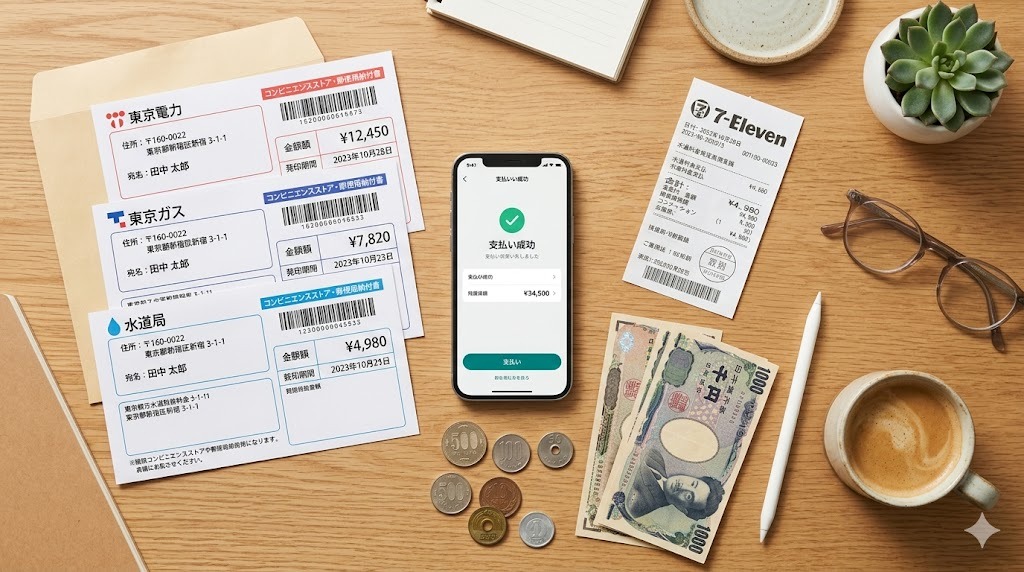
This is the most foreigner-friendly method since no Japanese bank account is required. When your bill arrives by mail, it includes a barcode payment slip (払込票 or 振込用紙). Simply take it to any 7-Eleven, FamilyMart, Lawson, or Ministop and hand it to the cashier. They’ll scan the barcode, you pay cash, and get a receipt. Easy.
- ✅ No bank account needed
- ✅ Available 24/7
- ✅ Receipt given immediately
- ❌ Cash only at most convenience stores
- ❌ You have to go in person
Method 2: Automatic Bank Debit (口座振替 — Kouza Furikae)
This is the most common payment method for long-term residents. You register your Japanese bank account with each utility company, and payments are automatically deducted on the due date. You’ll need: a Japanese bank account (see our bank account guide), your bank’s passbook or cash card, and the utility company’s registration form (口座振替依頼書).
Most utility companies offer a small monthly discount (¥55–¥110/month) for using automatic debit — worth setting up after you open a bank account.
Method 3: Credit Card Payment (クレジットカード払い)
Many utility companies now accept credit card payment, either online through their website or via phone registration. This is ideal for collecting points/miles. Check your provider’s website for the “クレジットカード払い” option. Note that some providers (especially local water authorities) may not offer credit card payment.
Method 4: PayPay & Digital Wallets
PayPay, Japan’s dominant QR payment app, now allows bill payment directly through the app. Open PayPay → tap “請求書払い” (Bill Payment) → scan the barcode on your paper bill → confirm. Accepted for many utility companies, NHK, and even some tax payments. This is becoming increasingly popular as it allows cashless bill payment without a bank account setup.
- ✅ Cashless and convenient
- ✅ PayPay points earned on some bills
- ✅ Works with PayPay balance loaded from convenience store
Method 5: Online Banking Transfer (振込 — Furikomi)
Some bills can be paid via bank transfer to the utility company’s account number. This is less common for regular utilities but used for things like condo management fees (管理費) or irregular one-time bills. Your bank’s ATM or online banking app can send a furikomi transfer.
Method 6: Direct Debit from Post Office (郵便振替)
Japan Post (ゆうちょ銀行) offers payment at post office windows using giro slips (払込票). If the slip has an orange header, it can be paid at the post office; blue-header slips are for banks. This is less convenient but available if you’re near a post office.
🏦 Setting Up Automatic Payments — Step by Step
Setting up automatic bank debit (口座振替) for all your utilities is the smartest move once you have a Japanese bank account. Here’s how to do it for each major bill type:
For Electricity & Gas
- Visit the utility company’s website and find the 口座振替 (auto-debit) registration page
- Fill in your bank name (銀行名), branch name (支店名), account type (普通 = savings), account number (口座番号), and account holder name (カタカナ)
- Some companies require you to mail a paper form — your bank passbook pages can be submitted as proof
- Confirmation takes 1–2 billing cycles; pay manually in the meantime
For NHK
Visit nhk.or.jp or call 0570-077-077 to register for automatic payment. English support is available. You can also set up credit card payment through the NHK website — often the easiest option for foreigners.
For Water
Go to your local city/ward office (市役所・区役所) with your bank passbook and seal (印鑑). Fill out their 口座振替 form. Some cities now accept online registration through their municipal website.
📄 How to Read a Japanese Utility Bill
Japanese bills look intimidating but follow a consistent format. Here are the key terms to look for:
| Japanese | Reading | Meaning |
|---|---|---|
| お客様番号 | Okyakusama bangō | Your customer/account number |
| 請求金額 | Seikyū kingaku | Total amount due |
| お支払い期限 | Oshiharai kigen | Payment due date |
| 検針期間 | Kenshin kikan | Billing period (dates) |
| 使用量 | Shiyōryō | Usage amount (kWh, m³) |
| 基本料金 | Kihon ryōkin | Base/fixed charge |
| 電力量料金 | Denryokuryō ryōkin | Usage charge (electricity) |
| 消費税 | Shōhizei | Consumption tax (10%) |
| 振込先 | Furikomi saki | Payment destination (bank account) |
🗂️ Income Taxes & Resident Tax in Japan
Taxes are a different category from utility bills but equally important for expats to understand. Here’s a quick overview — for the full guide, see our How to File Taxes in Japan article.
Resident Tax (住民税 — Juminzei)
Resident tax is a local tax charged by your city or prefecture, calculated at roughly 10% of your previous year’s income. If you’re a company employee (会社員), it’s deducted from your salary automatically (特別徴収). If you’re self-employed or freelance, you pay via quarterly installments using payment slips (普通徴収) sent from your ward/city office.
Payment methods for resident tax: convenience store (using the payment slip), PayPay bill payment, bank transfer, or credit card via your municipal government’s website. From 2023, many municipalities accept credit card payment with a small fee.
National Income Tax (所得税 — Shotokuzei)
For company employees, income tax is withheld at source (源泉徴収). Year-end adjustment (年末調整) handles most returns automatically through your employer. If you have additional income or need a refund, file a tax return (確定申告 — Kakutei Shinkoku) in February–March each year. Tax is paid to the national tax office (税務署) via bank transfer or at the post office.
❓ FAQ — Paying Bills in Japan as a Foreigner
Can I pay Japanese bills without a bank account?
Yes — convenience store payment works for almost all utility bills and requires only cash. PayPay (which can be loaded with cash at convenience stores) also works for many bill types. However, setting up auto-debit with a bank account is the most hassle-free long-term solution.
What happens if I miss a payment?
Utility companies will send a reminder notice (督促状 — Tokusokujo). If you continue to miss payments, service may be suspended (especially gas and electricity). Reconnection fees apply. Always pay before the due date (支払期限) shown on your bill.
My bill is entirely in Japanese. Can I get help?
Take a photo of the bill and use Google Translate’s camera feature to translate it. Alternatively, use the table above to identify key fields. For Tokyo area electricity (TEPCO) and Tokyo Gas, English customer service lines are available. Many ward offices (区役所) have multilingual staff or translation services.
Do foreigners have to pay NHK?
Yes, if you have a TV or TV-capable device, you are legally required to pay. The law applies to all residents of Japan regardless of nationality. NHK collectors (集金人) may visit your home; you can show them proof that you have no TV to avoid signing up if that’s genuinely the case.
Can I pay all bills with PayPay?
Many utility bills and resident tax payments can be paid via PayPay’s 請求書払い (bill payment) feature — just scan the barcode on your paper slip. However, not all municipalities and utility companies support PayPay yet. Check the PayPay app or the sticker on your bill that shows accepted payment logos.
I’m leaving Japan — how do I cancel utilities?
Contact each utility company at least 1–2 weeks before your move-out date to arrange service cancellation (解約 — Kaiyaku). You can call, fill out an online form, or for some providers, use their app. The final bill will be sent after disconnection, payable at a convenience store.
📌 Summary: Bill Payment Quick Reference
| Bill Type | Best Payment Method | Tip |
|---|---|---|
| Electricity | Auto-debit or credit card | Get ¥55–110/mo discount with auto-debit |
| Gas | Auto-debit or convenience store | Pay by due date to avoid disconnection |
| Water | Auto-debit via city office | Visit your ward office with passbook |
| Internet | Credit card (set up during contract) | Choose IIJ for English support |
| Mobile | Credit card or auto-debit | Set up at time of contract signing |
| NHK | Credit card via nhk.or.jp | Most convenient for foreigners |
| Resident Tax | PayPay or convenience store | Credit card via municipal website (+ fee) |
🔗 Related Articles
- How to Open a Bank Account in Japan as a Foreigner
- How to File Taxes in Japan as a Foreigner (Kakutei Shinkoku)
- Best Mobile Phone Plans in Japan for Foreigners 2026
- Japan Health Insurance Guide for Foreigners
Tax-free shopping in Japan changes on 1 November 2026
Until 31 October you show your passport at the till and simply pay without the 10% consumption tax. From 1 November you pay the full tax-included price in the shop and claim the tax back at the airport — at a customs kiosk or through Visit Japan Web — before you check in.
- The ¥5,000 minimum per shop, per day stays the same.
- The general-goods / consumables split is abolished, and so is the ¥500,000 cap on consumables.
- Sealed packaging is abolished — but consumables still have to leave Japan unused.
- Everything on the receipt has to be with you at departure. Customs can ask to see it.
Shopping before 1 November? Nothing changes for you yet.
🔥 Editor’s Picks for Life & Travel in Japan

Japan Expat Starter Kit 2026 PDF guide
Your first 90 days in Japan, step by step: 17 chapters · 24 pages · 100 phrases in Japanese script · 40 kanji · printable checklists. Bank account, My Number, health insurance, apartment, phone, taxes & pension.
$9.99 $4.99 current price
📥 Get the kit →📄 Read 5 pages free: contents + Chapter 2
⚡ Instant PDF download · 🛡️ 30-day money-back guarantee · 🔄 Free 2026 updates
Practical guides for life and travel in Japan — free, about once a week. No spam, unsubscribe anytime.
☕ Enjoying our Japan guides?
If this article helped you, you can support our work with a coffee!
🇯🇵 Travel & Life Essentials for Japan
Hand-picked gear to make your time in Japan easier. Available on Amazon US & Amazon Japan.
🔋 Portable charger
A must for long days of sightseeing and photos.
View on Amazon (US)View on Amazon Japan🔌 Travel plug adapter
Japan uses Type A outlets. Bring the right adapter.
View on Amazon (US)View on Amazon Japan🎧 Translation earbuds
Real-time translation to talk without barriers.
View on Amazon (US)View on Amazon JapanAs an Amazon Associate, Japan Life Lab earns from qualifying purchases.
Did this guide help you? 🍵
Japan Life Lab is a small independent blog, and every guide we publish is completely free — no paywalls, ever. If our work saved you time (or a headache), you can support us with a cup of Japanese tea. Every contribution, big or small, goes straight into keeping these guides free, accurate and up to date for everyone.
☕ Support Japan Life Lab
Leave a Reply