This article was created with AI writing assistance (ChatGPT, Claude, etc.). Product selection, specifications, and reviews are verified by the Japan Life Lab editorial team.
This article contains promotional / affiliate links.
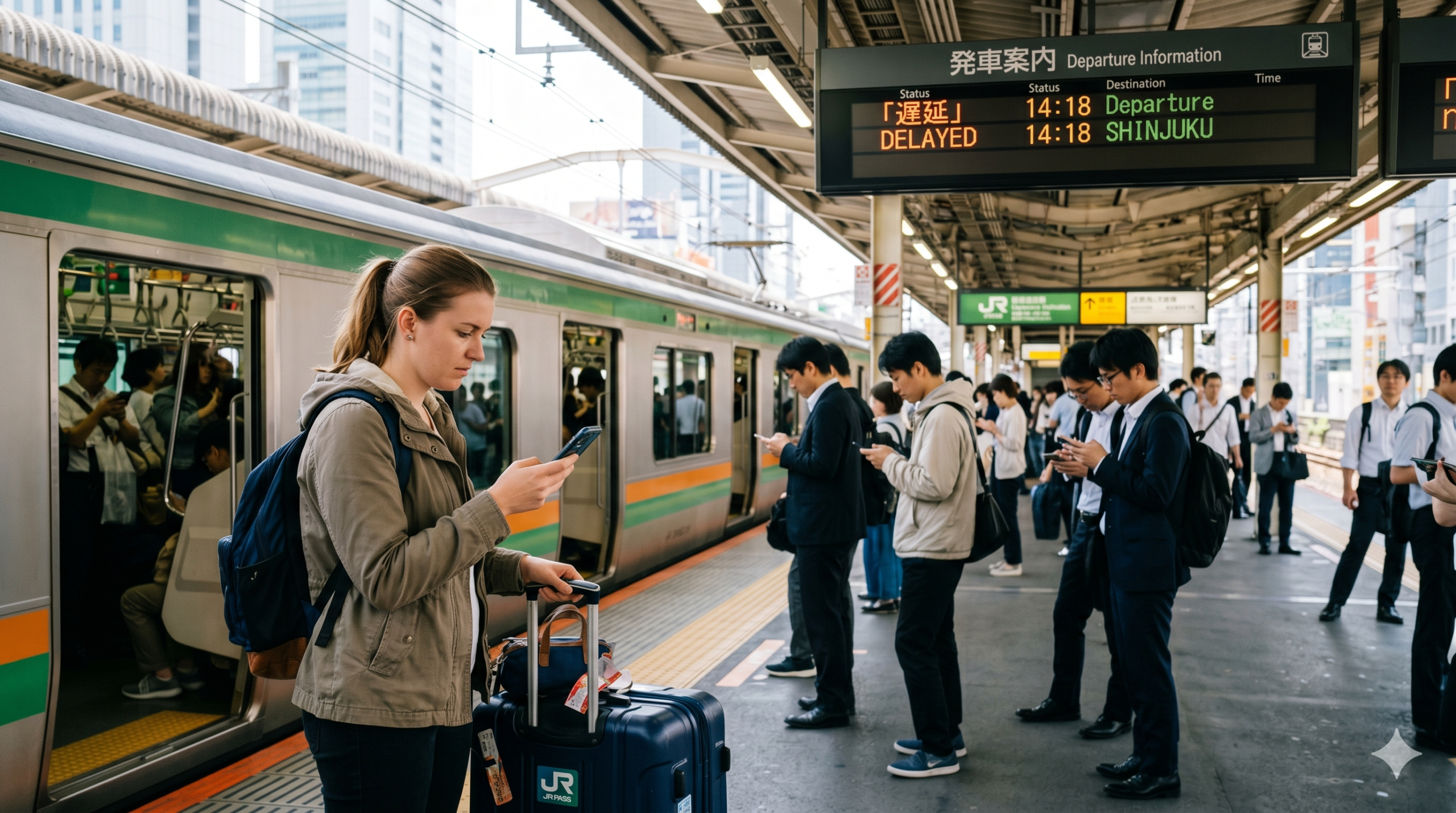
You’re standing on a platform in Tokyo, your train isn’t moving, and an announcement crackles over the speakers — entirely in Japanese. Stressful, right? Japanese trains are famously punctual, but delays (遅延) and full suspensions (運転見合わせ) do happen, especially during the June–October rainy and typhoon season. The good news: the system is built to help you. Once you know the steps, a stopped train is just a minor detour. This guide shows you exactly what to do — read the announcements, check live status, get a delay certificate, use free alternative transport, and claim refunds — so you’re never stuck and confused again.
📌 What you will learn
You do not have to read it all — jump to what you need.
- First, understand the announcements
- Step 1: Check live status on your phone
- Step 2: Get a delay certificate
- Step 3: Use free alternative transport (furikae yuso)
- Step 4: Refunds
- Typhoon season: planned suspensions
- Be prepared: gadgets that save a stranded traveler
※ Start wherever fits your situation.
First, understand the announcements
✅ Updated for July 2026 — prices and product information refreshed.
A few keywords turn panic into a plan. These appear on station signs and in apps:
| Japanese | Reading | Meaning |
|---|---|---|
| 遅延 | chien | Delay — trains late but still moving |
| 運転見合わせ | unten miawase | Suspension — trains temporarily stopped |
| 計画運休 | keikaku unkyu | Planned suspension — stopped in advance (typhoons) |
| 運転再開 | unten saikai | Service resumed |
| 振替輸送 | furikae yuso | Alternative transport — another line, same ticket |
| 遅延証明書 | chien shomeisho | Delay certificate (proof of lateness) |
Step 1: Check live status on your phone
Before anything else, find out what’s happening and how long it will last. The fastest way is an English transit app:
- Japan Transit Planner (Jorudan) / Yahoo Norikae Annai — live delay info and automatic rerouting around the stopped line.
- NAVITIME for Japan Travel — English, with real-time disruption alerts.
- Google Maps — transit mode flags major delays and suggests alternatives.
- Official railway sites / X accounts — JR East, Tokyo Metro and others post the latest status, often in English.
If the app says the suspension may last 30+ minutes, don’t just wait — go to Step 3 and take another route.
Step 2: Get a delay certificate
If the train made you late for work, school, an interview, or a tour, get a delay certificate — an official document proving the train ran late. Showing it is a completely accepted excuse for lateness in Japan, and no one will blame you.
Big 2026 update: railways are going digital. From April 1, 2026, Tokyo Metro issues delay certificates online only (no more paper at the gate), and JR East and Tokyu also offer electronic certificates on their websites. So the easiest method now is:
- Online (recommended): open the railway’s “delay certificate” web page, pick the date and line, and download or screenshot it. Usually issued for delays of 5+ minutes.
- At the station: for companies that still hand them out, ask staff near the ticket gate. The phrase: “Chien shomeisho o kudasai.”
Certificates are usually available only on the day of the delay (or a few days after, online), so act promptly.
Step 3: Use free alternative transport (furikae yuso)
When a line is suspended, railways often arrange alternative transport: ride a different company’s parallel line to your destination using your existing ticket — at no extra charge. Show your ticket or pass to staff and they’ll point you the right way.
Catch for tourists: this mainly applies to paper tickets and commuter passes; rules for IC cards (Suica/PASMO) differ and sometimes you must speak to staff before tapping out. When unsure, ask an attendant: “Furikae yuso wa dekimasu ka?” If you tapped in with Suica, don’t tap out at a different company without asking, or you may be charged twice.
Step 4: Refunds
- Train fully suspended and you give up the trip: you can usually refund the unused ticket at the ticket window.
- Limited Express / Shinkansen badly delayed: if a limited express arrives 2+ hours late, the express surcharge (not the base fare) is typically refunded — keep your ticket and ask at the window.
- IC card: if you tapped in but couldn’t travel, staff can cancel the entry so you aren’t charged.
Keep your ticket and go to the staffed ticket office, not the automatic gate, for refunds.
Typhoon season: planned suspensions
During typhoons and heavy rain (peaking June–October), railways announce planned suspensions a day or two ahead and stop service entirely for safety — exactly what happened during the early-season typhoon in July 2026. If a big storm is forecast:
- Check railway websites and weather apps 1–2 days ahead; planned suspensions are announced early.
- Avoid tight airport transfers on storm days — trains and airport rapid lines may stop.
- If you must travel, go early; service often winds down hours before the peak and resumes slowly afterward.
Be prepared: gadgets that save a stranded traveler
Every step above needs a working phone with data. If your battery dies on a stopped platform, you can’t check routes, get a certificate, or call anyone. Two cheap items make all the difference.
1. A compact power bank. Keep a 10,000mAh charger in your day bag so you can keep checking status during a long delay.
2. Reliable mobile data (eSIM or pocket Wi-Fi). Delay apps are useless without internet — see our internet guide below to stay connected anywhere.
Useful Japanese phrases for train trouble
| English | Japanese (romaji) |
|---|---|
| Please give me a delay certificate. | Chien shomeisho o kudasai. |
| Can I use alternative transport? | Furikae yuso wa dekimasu ka? |
| When will service resume? | Unten saikai wa itsu desu ka? |
| I’d like a refund, please. | Haraimodoshi o onegai shimasu. |
| How do I get to ___? | ___ made do ikeba ii desu ka? |
FAQ
Are Japanese trains really often delayed?
No — they’re among the most punctual in the world. Minor delays of a few minutes can happen at rush hour; full suspensions are usually due to weather, accidents, or signal trouble. That’s exactly why the delay-certificate system exists.
Does a delay certificate cost anything?
No, it’s free — whether online or from staff.
My Suica won’t let me exit after a suspension. What do I do?
Go to the staffed gate (not the automatic one) and explain. Staff can correct the entry so you aren’t double-charged.
🚉 More Japan transport & travel guides
📘 Everything You Need to Settle in Japan — in One PDF
Banking, health insurance, My Number, housing, mobile plans, taxes & daily Japanese phrases. Save weeks of confusion with the complete Japan Expat Starter Kit.
📥 Get the Guide — $9.9930-day money-back guarantee
🔥 Editor’s Picks for Life & Travel in Japan
Practical guides for life and travel in Japan — free, about once a week. No spam, unsubscribe anytime.
☕ Enjoying our Japan guides?
If this article helped you, you can support our work with a coffee!
Did this guide help you? 🍵
Japan Life Lab is a small independent blog, and every guide we publish is completely free — no paywalls, ever. If our work saved you time (or a headache), you can support us with a cup of Japanese tea. Every contribution, big or small, goes straight into keeping these guides free, accurate and up to date for everyone.
☕ Support Japan Life Lab
Leave a Reply